
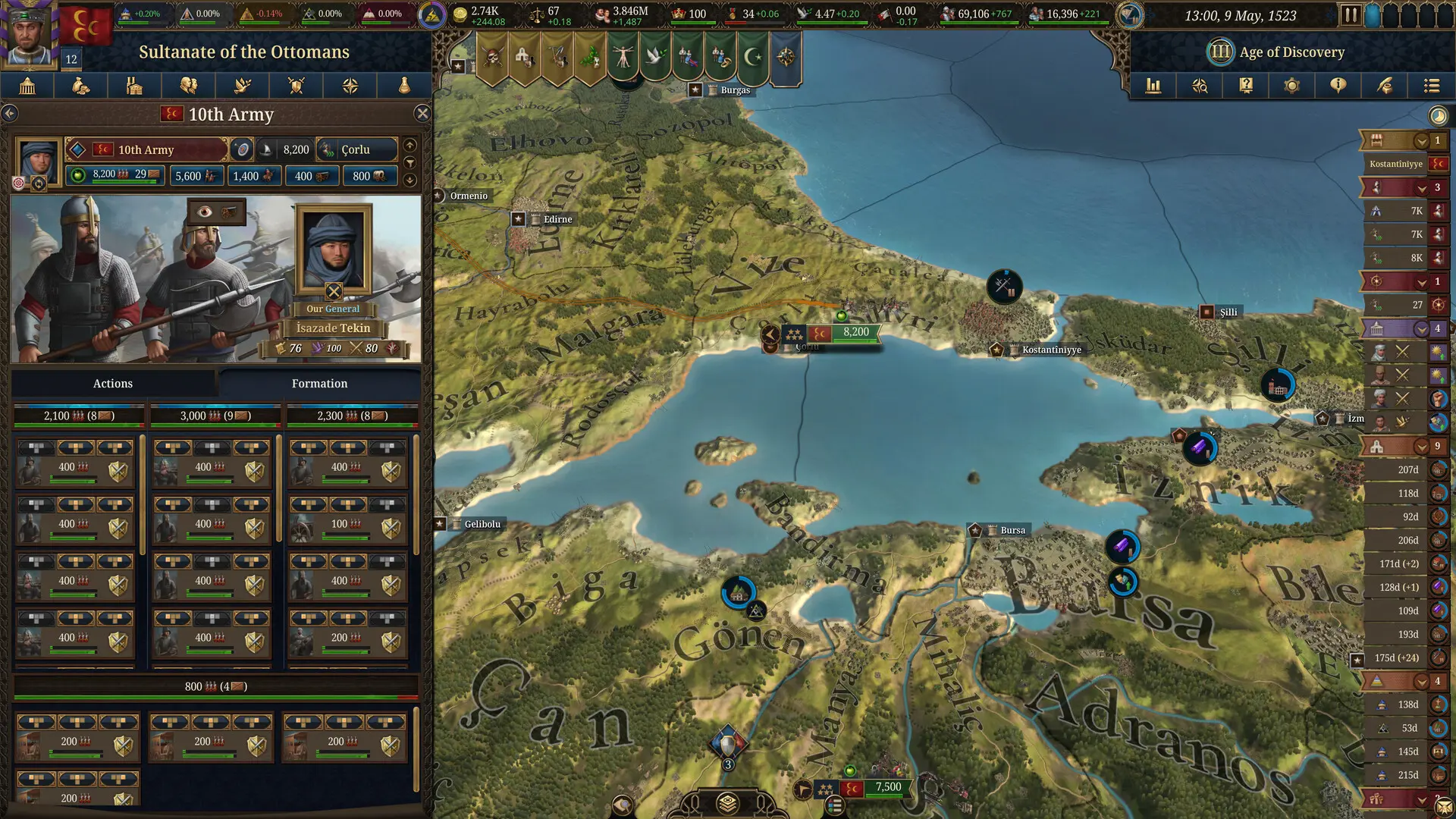
Europa Universalis V leans heavily on population-derived troops during the early Ages, and as a result, levies shaper your early military power in the game. And today I am here to help you better understand how levies work, how to grow them, and everything else for a smooth run.
What Levies Are
Levies in EU5 are soldiers that you pull directly from your population. During wartime or rebel suppression, the game lets you convert pops into military units through the Military – Armies interface.
They don’t cost ducats to maintain, which makes them your primary force early on when technology is low and regulars have significant upkeep.
Calling them “free” would be misleading, though.
When levies are active, the pops serving as soldiers stop working in their provinces. Casualties shrink provincial population until natural growth replaces the losses. Provinces that provide these troops also take a penalty on food and raw materials output while the levies remain raised.
Levies vs Regulars
Regulars are professional soldiers tied to your manpower pool. They reinforce after battles, don’t pull workers out of your economy, and don’t reduce provincial production.
Their discipline is higher, they don’t lose experience every month, and they don’t suffer the levy-only recruitment penalties linked to control, culture, or the “recently raised” modifier.
The biggest drawback? They’re not cheap. Especially during the early ages, sustaining large armies of regulars is impossible – therefore the need to rely on levies, at least partially.
There are also a few other important differences you must keep in mind when thinking about waging war or defending against enemies:
Unit size: levies sit at 1,000 soldiers in Ages 1-4, while regulars scale 100 – 200 – 400 – 800 as Ages progress. This mismatch makes Levy infantry significantly larger in raw numbers during the opening Ages.
Damage taken from regulars: However, levy units take additional damage when fighting regular troops. The penalty starts at +250% in Age 1 and halves every subsequent age.
Cons: Levies suffer a flat -10% discipline penalty at all times and they also lose 2% experience every month and lose all XP when disbanded. Regulars retain experience and don’t decay. They also cause a -20% penalty to food and raw materials output in their home provinces while deployed.
Also read: Europa Universalis V: All Formable Countries
How Levies Work in EU5
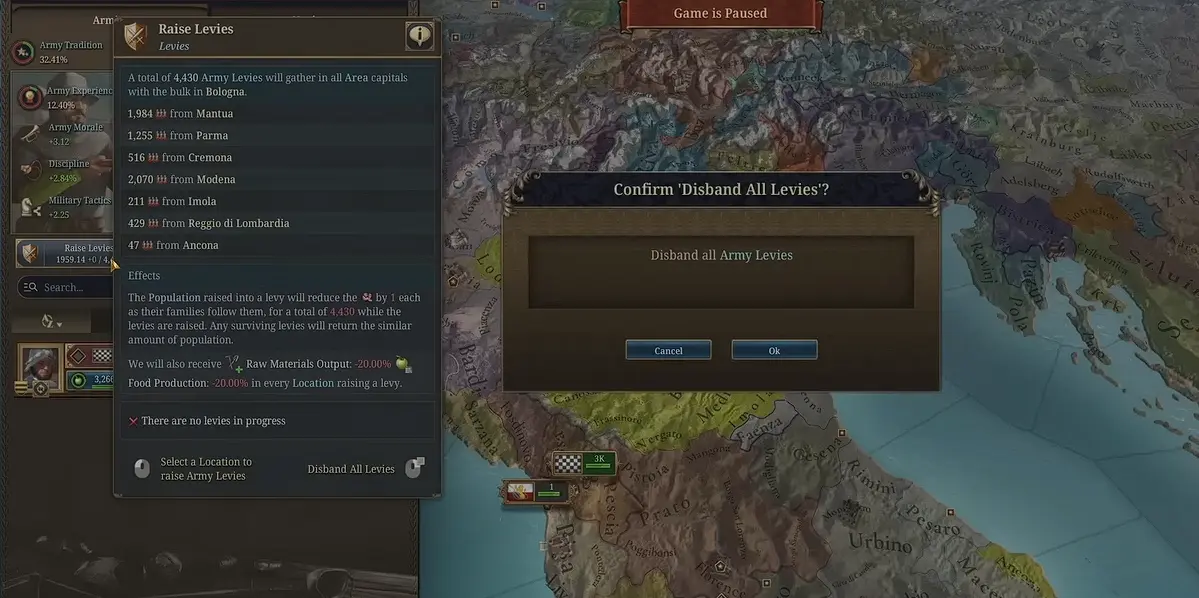
Levy recruitment is limited to wartime and rebel combat. You raise them through the Armies tab in the Military menu, selecting provinces capable of providing them. Once raised, each levy unit directly corresponds to people being pulled out of that province’s workforce.
If a levy unit takes casualties, the long-term impact is simple: the dead pops are gone. This can slow province growth significantly, especially in rural areas.
Disbanding Location Matters
Surviving levies return to their home provinces when disbanded. If this happens on your own land, they return quickly.
Doing it outside your territory delays their return and slows population regrowth. If you disband them in an occupied or foreign land, that delay becomes even longer. This is why it’s ideal to disband them in your territory.
How Levies Replenish
Replenishment depends on:
- Control: more control means stronger levy contribution and faster refill.
- Prosperity: prosperous provinces recover levies and population faster.
- Total population: larger provincial populations have higher recruitment and replenishment potential.
The “recently raised levies” modifier reduces how many soldiers a province can provide until enough time passes.
How to Get More Levies
Since EU5 levies originate directly from your population, scaling your population is the most straightforward and most important route to larger levy numbers.
Prosperity, strong food production, and storage buildings help accelerate growth. Long, destructive wars reduce food output, which slows everything.
Rural areas and coastal provinces tend to grow faster due to better food supply capacities, making them strong levy bases as long as they remain stable.
Using Control and Infrastructure
Control affects how much a province contributes to both manpower and taxes. It radiates outward from your capital. Control spread is increased by expanding your road networks, improving maritime presence and investing in infrastructure near your capital.
High control both widens the radius of eligible provinces and raises the number of levies each province can contribute.
Levy Laws, Estates, and Government Reforms
Levy size is also shaped heavily by government decisions. The Levy Laws category in Government – Laws – Military Laws lets you assign policies that change the number and type of levies available.
These can increase the overall levy pool or alter which social classes supply soldiers, but usually have const associated as well.
Estates also matter:
- Nobles provide cavalry and elite troops.
- Peasants supply the bulk of levy infantry.
- Other estates add different troop types depending on your laws.
Estate satisfaction influences how many levies you get. Dropping under fifty percent satisfaction means fewer soldiers, so maintaining positive relations with estates is necessary to preserve your levy pool.
Privileges and reforms can shift estate contributions or unlock stronger levy types as your government evolves. To better understand how everything works and is connected in the game, I recommend reading my EU5 Guide to Ages and Institutions.
Avoiding Levy Burnout
Although levies don’t cost ducats, mismanaging them can drag your economy down. Provinces used to recruit levies suffer a -20% hit to food and raw material output until those levies return home, so using the same provinces repeatedly can cripple their production.
Rotating recruitment across different regions spreads this penalty out so no province becomes unstable.
Another consideration is experience decay. Levies lose around 2% experience every month, and extended campaigns leave them with little effectiveness. They’re far better for short wars or quick defensive actions than for drawn-out conflicts.
Levies Across the Ages in EU5
Ages 1–3
This is when levies truly dominate. Even though the current implementation keeps levy unit size at 1,000 soldiers per unit through Ages 1–4, regular units only start at 100, as mentioned before.
This mismatch makes early levies extremely strong in raw numbers and often superior to regular infantry throughout the first two ages, at least.
Even by Ages 3–4, levies remain efficient despite the extra damage they take from regulars. Their size alone carries a lot of combat value.
A Couple of Quirks
Two advances create problems for levy-focused nations in the early game due to the fixed 1,000-unit levy size.
Matchlock (Age 3): Reduces the levy damage-taken penalty vs regulars, cuts burgher and commoner levy contribution from 5%/2% to 1%/1%. This results in fewer levies overall and weaker recruitment potential and offers no meaningful compensation, despite the reduced damage-taken modifier.
Flintlock (Age 4): Works similarly to Matchlock but improves levy strength by 1.5. You still end up receiving far fewer soldiers because levy unit size stays fixed instead of scaling, and the strength boost doesn’t outweigh the reduction in available levy numbers.
Militiamen and Conscripts
Levies become viable again in the late Ages when two new things come in play:
Militiamen (Age 5): This increases the levy strength: 2.25 and increases the unit size to 1,600, making them a solid supplement to regulars.
Conscripts (Age 6): This increases the levy strength even more (3) and the unit size becomes 3,200. At this stage, levies can form significant late-game infantry lines again, especially for large countries with tons of people to recruit.
Recommended Age-by-Age Strategy
This obviously varies depending on the nation you play as, how well things are going for you and many other things, but for a general levy-related strategy in Europa Universalis V, here’s what to know:
- Ages 1-3: rely primarily on levies. Use regular artillery for siege work and consider a few regular cavalry or heavy cavalry for flanks.
- Age 4: start shifting resources into regular troops. Levies are still usable but no longer dominant.
- Ages 5-6: focus on regulars for your main forces, using newly buffed levies as additional infantry mass.
This is basically the historical way professional armies replaced feudal levies once technology and economies improved and became established.
TIP: War Preparation and Costly Mistakes
EU5 is a 4X game with many interlocking systems, so one mistake can ripple through your population and levy numbers.
Starting a war without a Casus Belli, for instance, adds extra costs that make levy-heavy strategies harder to sustain. Damaged provinces recover population slowly, which means fewer future levies and weaker long-term military capacity.
More Tips & Tricks
As we’ve seen already, levies are best for early conflicts (ideally short ones), as well as defensive wars where you can disband troops quickly and recover population. They are also good in situational conflicts, for example, when artillery is needed but regular infantry upkeep is too costly.
Pairing levy infantry with regular artillery offers strong siege potential without overspending. Adding a few regular cavalry units provides flanking strength that levies can’t match.
However, you should always consider the costs and cons when building up your levy army. Treating levies as if they have no economic consequences is a huge mistake, so don’t pull from the same provinces repeatedly, and don’t take Matchlock or Flintlock without checking how they will shrink your levy pool under current mechanics.
Conclusion
EU5 levies remain essential for the first half of the game and keep their value even later through Militiamen and Conscripts. Used with care, they let you power through the early ages and build momentum for a perfect run.
Do you have additional questions or comments to make about levies in Europa Universalis V? Let us all know by sharing your thoughts below.
Or, if you want something lighter (but still fun), I recommend checking out my Whiskerwood Guide.

- Rooms & Exits Kitchen Walkthrough (Level 11, Chapter 3 – Murder Dressed in White) - October 15, 2026
- Rooms & Exits Garden Walkthrough (Level 10, Chapter 3 – Murder Dressed in White) - October 15, 2026
- Rooms & Exits Complete Walkthrough Index by Chapter and Level - October 12, 2026