
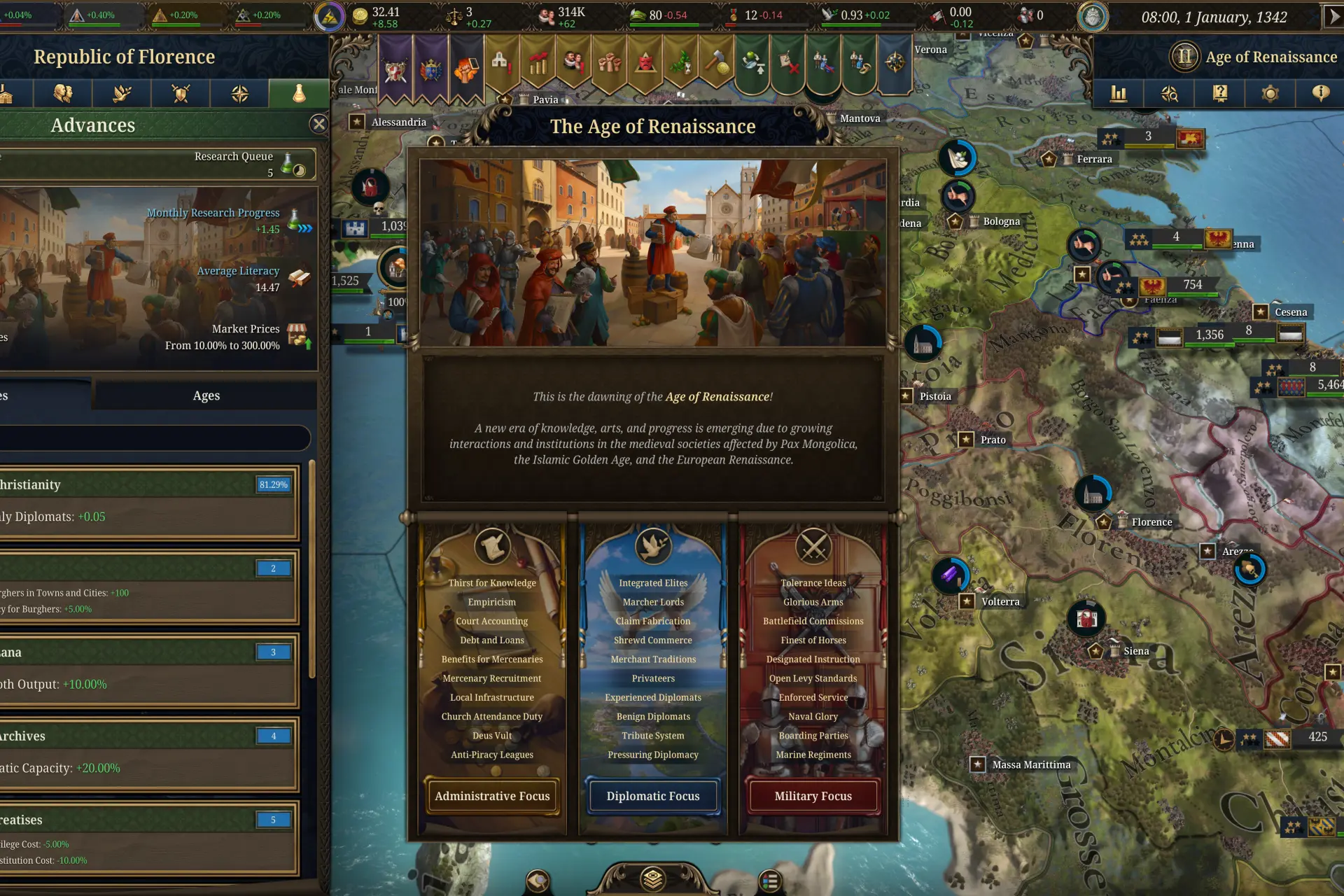
If Europa Universalis IV had “Ages of Discovery” and “Golden Eras,” Europa Universalis V builds on that with its own set of ages, or eras that rewrite how your nation functions, defining the technologies you unlock, the institutions that shape your economy, and even how you wage war or build cities.
While you will get used to these as you play more and more, it doesn’t hurt to have everything at a glance, sprinkled with some tips and tricks to make everything better.
And that’s exactly what I am doing in today’s article, listing all the ages in EU5, the three institutions in each and what everything means for you.
The Age System Explained
The age system in EU5 ties everything in the game into one evolving framework and is as historically accurate as possible.
At the start of every new age, you pick your national focus:
- Administrative Ability for internal growth and reforms.
- Diplomatic Ability for trade, alliances, and expansion through charm or subtle pressure.
- Military Ability if you prefer solving problems with cannonballs.
This focus shapes how your advance tree develops. Each age brings its own set of advances. Together with Institutions, these advances define how modern – or backward – your realm becomes.
Each age lasts around 100 years, so you will get a total of six major ages as you play.
Institutions represent big cultural or scientific leaps (like Feudalism, Printing Press, or Industrialization). Institutions spread gradually across the map. Embracing them unlocks new branches in your Advance Tree and accelerates their own spread from your capital. Delaying adoption limits which branches and bonuses you can access.
Advances are the smaller innovations within an age (e.g., new artillery models, farming methods, or administrative systems).
Control and Literacy determine how fast new ideas spread through your provinces. A literate, well-governed capital can pull your entire realm into a new era—while a fractured empire might still be stuck in medieval feudalism by the time France is inventing railroads.
Speaking of France… if you’re curious about all the possible formable nations in the game, I have a guide for that, here: Europa Universalis V: All Formable Countries and How to Get Them.
The Six Ages of Europa Universalis V
Here’s the big picture before we go into each in detail:
| Age | Start Year | Core Themes | Institutions |
|---|---|---|---|
| Age of Traditions | Game Start | Feudal power, loyalty, religion | Feudalism, Legalism, Meritocracy |
| Age of Renaissance | 1342 | Urbanization, diplomacy, wealth | Renaissance, Banking, Professional Armies |
| Age of Discovery | 1437 | Expansion, exploration, literacy | New World, Printing Press, Pike & Shot |
| Age of Reformation | 1537 | Faith, trade, mercantilism | Confessionalism, Artillery, Global Trade |
| Age of Absolutism | 1637 | Centralization, scientific reform | Manufactories, Scientific Revolution, Military Revolution |
| Age of Revolutions | 1737 | Enlightenment, industrialization | Enlightenment, Industrialization, Levée en Masse |
Now, let’s find out all the details about each in-game age!
Age of Traditions (Game Start)
The world begins here: fragmented, hierarchical, and defined by loyalty more than literacy. The Age of Traditions sets the medieval stage of Europa Universalis V, where monarchs, nobles, and priests hold the power.
Key Gameplay Effects:
- −10% Control Impact on Warscore
- Three foundational institutions: Feudalism, Legalism, Meritocracy
- Market volatility up to 300%, with 10% price stability
At the start, there are no hegemons – no dominant powers yet, just feudal states jostling for control. The economy runs on land and loyalty. Wars are local and slow-moving.
Institutions of the Age
- Feudalism (Aachen) – Grants +100 Possible Nobles, reinforcing vassal networks and feudal levies.
- Legalism (Rome) – Boosts Local Pop Promotion Speed by +50%, supporting bureaucratic growth.
- Meritocracy (Khanbaliq) – Adds +0.25 Cultural Tradition, rewarding balanced and educated governance.
Strategy Tip:
Focus on internal development and securing stable vassal structures. High Literacy pays off later when the Renaissance hits. Don’t overexpand – you’ll need resources to embrace future institutions without tanking stability.
Also read: Best RPGs with Romance and Relationship Options
Age of the Renaissance (Starting 1342)
Welcome to the early modern world. Cities bloom, merchants rise, and diplomacy becomes as deadly as war. The Age of the Renaissance rewards nations that urbanize, trade, and invest in culture (or keep doing so).
Key Gameplay Effects:
- −20% Control Impact on Warscore
- +100% Expected Army Size
- +25% Diplomatic Capacity and Cultural Tradition
- +10% Antagonism Religion Influence
- −10% Levy Combat Efficiency, +10% Levy Maintenance
- −20% Navy Levy Size
With higher expected army size and levy maintenance penalties, conflicts scale up in cost and scope.
Institutions of the Age
- Renaissance (Florence) – +0.5 Local Cultural Influence. Spawns in urban centers or university towns in Emilia/Lombardy.
- Banking (Genoa) – +1% Local Monthly Prosperity. Favors capitalist economies with large burgher populations.
- Professional Armies (Paris) – +50% Monthly Manpower. Triggered by Quality-oriented states with manpower and military focus.
Strategy Tip:
Urbanization is king. Stack Literacy and Burgher population to accelerate spread.
Also read: Astral Ascent Guide
Age of Discovery (Starting 1437)
The world opens up. Discovery supercharges exploration and colonization with faster missions and cheaper upkeep.
Key Gameplay Effects:
- −40% Control Impact on Warscore
- +200% Expected Army Size
- +0.25 Exploration Mission Monthly Progress
- −25% Colonial Maintenance Cost
- +15% Religious Antagonism Influence
- −20% Levy Combat Efficiency, +25% Levy Maintenance
- −75% Navy Levy Size
Institutions of the Age
- New World (Sevilla) – +50% Monthly Sailors. Triggers once the Americas are discovered; favors Western Europe.
- Pike & Shot (Innsbruck) – +20% Local Weaponry Output. Spawns in militarized states with Professional Armies and the Gunpowder advance.
- Printing Press (Mainz) – +5% Local Max Literacy. Requires a university, paper production, and Innovative societal values.
Strategy Tip:
This age defines the future superpowers. If you’re inland, rush Innovation values and Printing Press adoption to stay competitive or risk being out-teched for centuries.
Also read: 23 Best Cozy & Relaxing Games for PC
Age of Reformation (Starting 1537)
This age is about belief, rebellion, and economic realignment. Europe fractures between reformers and the old guard, trade centers explode in importance, and ideology becomes as deadly as artillery.
Key Gameplay Effects:
- −60% Control Impact on Warscore
- +300% Expected Army Size
- +33% Global Pop Conversion Speed
- −25% Trade Maintenance
- +20% Religious Antagonism, +10% Cultural and Government Type Influence
- −30% Levy Combat Efficiency, +50% Levy Maintenance
- −100% Navy Levy Size
This is where the map goes chaotic. Religion becomes a weapon. Faiths compete for dominance, heresies spawn new powers, and the trading nations that adapt fastest make a fortune while empires tear each other apart.
Institutions of the Age
- Confessionalism (Augsburg) – +100% Local Pop Conversion Speed. Appears in Catholic regions with strong religious values and Printing Press infrastructure.
- Artillery (Constantinople) – +50% Local Cannon Output. Requires Professional Armies and a Gunsmith/Tools Guild; driven by Offensive societal values.
- Global Trade (Lisbon) – +2.5% Market Attraction. Demands both Banking and New World institutions, plus an active trade hub that’s moved at least 500 goods.
Strategy Tip:
Pick your side early. Catholic nations benefit from unity bonuses and easier diplomacy; Protestant states can turbocharge literacy and innovation. Trade-focused countries can use Global Trade to dominate markets while everyone else fights over doctrine.
Age of Absolutism (Starting 1637)
Welcome to the power age! Monarchs rule absolutely, armies professionalize, and centralization and professionalization accelerate military and administrative reforms.
Key Gameplay Effects:
- −80% Control Impact on Warscore
- +400% Expected Army Size
- +50% Income from Colonial Subjects
- −10% War Score Cost
- +2 Construction Center Max Level
- −33% Revoke Privilege Cost
- +25% Integration Speed
- +10–20% Cultural, Religious, and Government Influence
- −40% Levy Combat Efficiency, +75% Levy Maintenance
- −200% Navy Levy Size
- −10 Loyalty of Subjects
By this point, Europe’s small feudal armies are gone and instead are replaced by massive standing forces and bureaucracies that eat gold for breakfast. Expansion speeds up dramatically, but keeping control becomes a balancing act.
Institutions of the Age
- Manufactories (Derby) – −25% Building Cost. Requires Banking and a major Burgher population (20,000+). Ideal for industrial or capitalist economies.
- Scientific Revolution (Cambridge) – +10% Local Max Literacy. Appears in university cities with strong Innovation values and the Printing Press.
- Military Revolution (Stockholm) – +0.001 Local Monthly Development. Comes from capitals with Pike & Shot, Artillery, and high Offensive societal values.
Strategy Tip:
Centralize or die. The best nations in this age are the ones that can manage loyalty and bureaucracy simultaneously. Build Manufactories everywhere, rush the Scientific Revolution for literacy, and modernize your army early.
Age of Revolutions (Starting 1737)
By now, the world has changed beyond recognition. This final age marks the rise of ideology, mass mobilization, and the birth of industrial power and a ultimate fight for your nation to become a global superpower.
Key Gameplay Effects:
- −100% Control Impact on Warscore
- +500% Expected Army Size
- +100% Income from Colonial Subjects
- −20% War Score Cost
- +5 Construction Center Max Level
- +20–25% Cultural, Government, and Societal Influence
- −50% Levy Combat Efficiency, +100% Levy Maintenance
- −200% Navy Levy Size
- −30 Loyalty of Subjects
This is the age where empires collapse and new powers rise overnight. Massive industrial economies outproduce old aristocracies, and global wars become total wars.
Institutions of the Age
- Enlightenment (Paris) – −5% Unrest. Requires a university, high Literacy (31+), and Scientific Revolution. Driven by Innovative societal values.
- Industrialization (Blackburn) – +5% Production Efficiency. Needs Manufactories, a large urban base (2,000+ Burghers), and heavy Capital Economy values.
- Levée en Masse (Paris) – +25% Levy Size. Spawns in capitals with massive populations (200,000+) and strong Quantity societal focus.
Strategy Tip:
This is where you cash in everything you’ve built. Industrial nations become monsters, especially if you’ve stayed ahead on Literacy and Innovation. If you’re lagging behind, pivot fast: embrace Industrialization early, modernize your army with Levée en Masse, and use Enlightenment to stabilize your population before it tears your empire apart.
Wrapping up
The progress of the ages will come naturally and you will master them as you play. It’s good to always have a plan in order to build your country for the coming nation and always having the final goal (and age) in mind.
If you adapt fast, you’ll lead the march of progress. If you don’t – expect to be conquered by someone who did. It’s that simple!

- Rooms & Exits Kitchen Walkthrough (Level 11, Chapter 3 – Murder Dressed in White) - October 15, 2026
- Rooms & Exits Garden Walkthrough (Level 10, Chapter 3 – Murder Dressed in White) - October 15, 2026
- Rooms & Exits Complete Walkthrough Index by Chapter and Level - October 12, 2026