
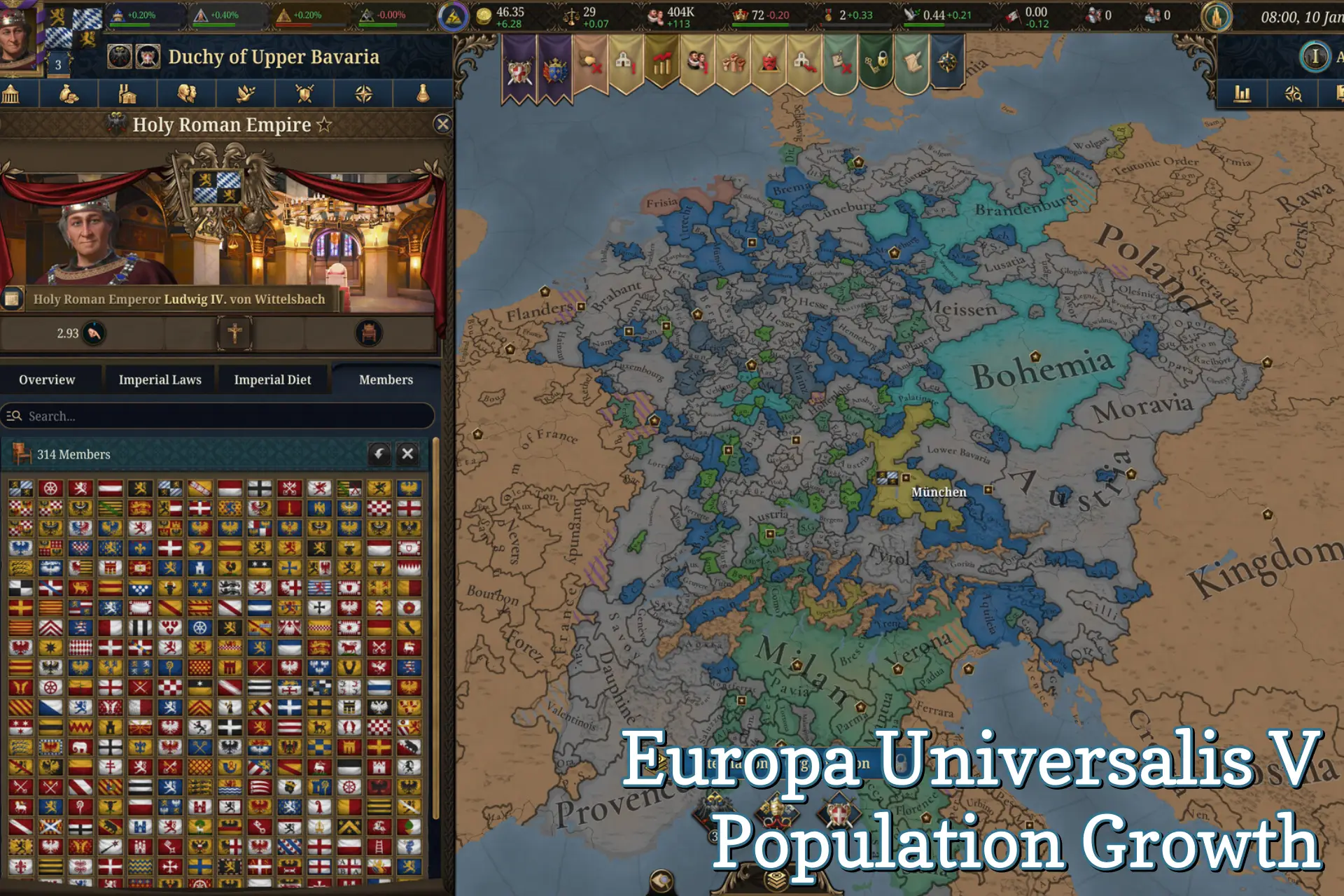
Population growth in Europa Universalis V is essential for creating a country that has a solid economy, enough manpower whenever needed, and flawless expansion pacing. However, population growth seems minimal early on (around 0.5%) so… how to increase population growth in the game?
Today’s guide covers everything you need to know about this topic, helping you better understand how population works as a whole (growth included) and what to do to improve your chances.
How Population Growth Works
Each location in the game updates population monthly through births, deaths and migration flows.
Growth is tied to your Population Capacity, which depends on terrain, vegetation, climate, and development of the area.
Locations far below capacity grow faster because there is space for new households. Once the population approaches its limit, the rate slows sharply. Even more, if a province is too crowded or unappealing, migrants begin moving out, which blocks growth (or even results in population loss), even when birth rates are positive.
So even though it seems that there’s a cap on population growth, I think it’s just a case of migration making things more difficult. So even if you have solid food production and birth rates are solid, you could see poor numbers because the location has reached capacity or is losing people to another site with higher attraction.
At the same time, don’t forget that various mechanics (such as levies in EU5) can influence population, so always look at the big picture when trying to find the real problem.
Food supply and health
Food directly affects both growth and capacity. If supply dips, provinces suffer penalties that reduce growth and may even lower their usable capacity.
Maintaining stable farms, fisheries, and markets keeps food flowing. Large local stockpiles help provinces recover and can speed up growth during rebuilding phases.
Disease events slow growth by raising death rates. Hospitals help mitigate these losses, but they do not increase population growth; their role is limited to protecting existing people from disease impact – and this might have a direct effect over your population, if you have more births than deaths.
Prosperity and satisfaction
Prosperity raises growth and helps stabilize provinces. If an area suffers devastation or collapses through disease, the cabinet action for restoring prosperity gives a temporary growth benefit.
Satisfied populations also maintain better health and remain in place, keeping migration flows stable rather than draining away to rival locations.
Early-Game Population Limits
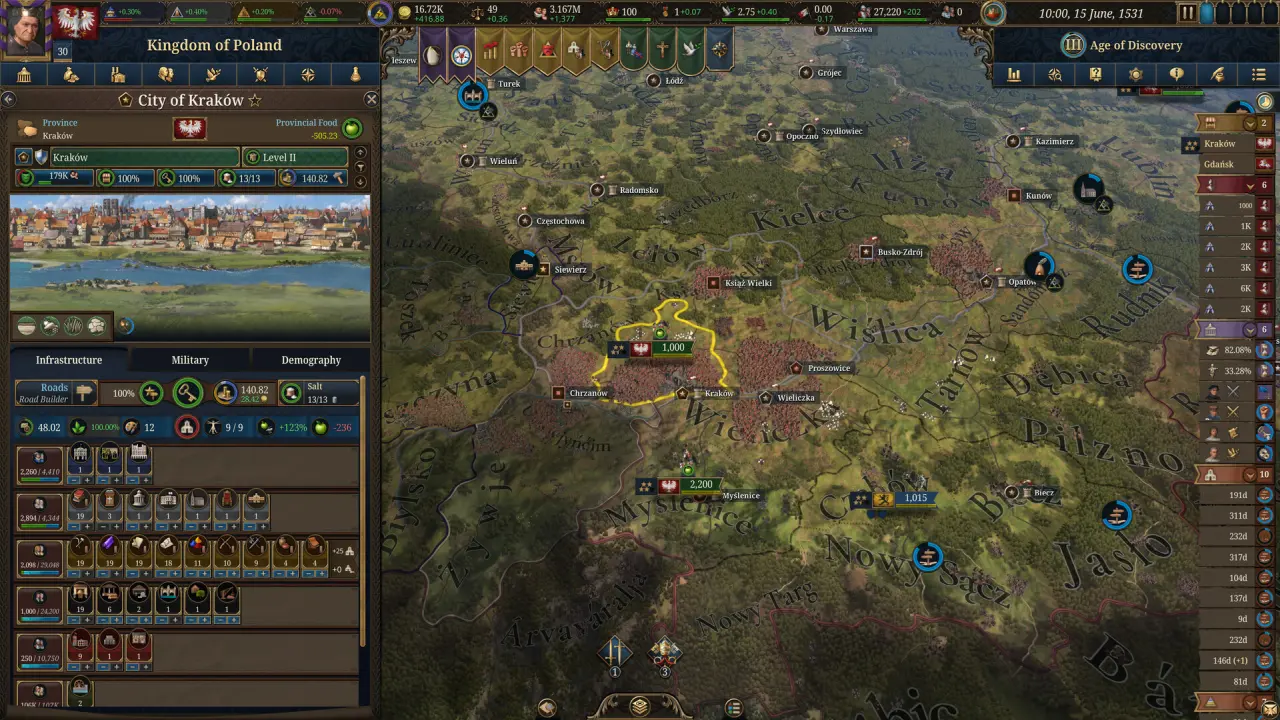
Most nations encounter the same early plateau (at around 0.5%). Low prosperity, small food stockpiles and undeveloped terrain limit how quickly numbers rise.
With little infrastructure and low-capacity locations, even solid food production cannot lift growth beyond this range.
Promote Migration
This is a mechanic that might be confusing when used. You might be tempted to believe that using Promote Migration will pull people to your nation, but it only redirects pops within your own market, meaning your states and your vassals.
If your market is tiny, movement is minimal. This is why a Brabant player sees little impact, for example – there are not enough external sources to pull from.
Stagnation is not the end of a campaign!
While the early population growth cap in the game is annoying, it’s not the end of the world. It is true – it’s frustrating and options are limited early, but the game opens more tools later, and I’ll cover them below.
Increasing Population Growth in Europa Universalis V
Raising capacity is one of the strongest but least understood growth levers in the game. It increases through development improvements and better terrain or vegetation conditions.
In other words, upgrading towns, cities and infrastructure contributes to higher caps, giving provinces room to grow beyond their natural ceiling.
Reliable food production prevents penalties and gives provinces room to build reserves. If food shortages occur, both growth and capacity fall, slowing your entire state.
Protecting pops from losses
Military casualties reduce your long-term growth – levies or regular troops – while mercenaries, if afforded, can reduce population losses. This is why it’s extremely important to manage your military correctly, especially early on when you want to see that massive, constant growth.
For a better understanding of all the game’s mechanics, I recommend checking out my Europa Universalis V guide to Ages and Institutions.
Understanding migration attraction
As seen above, migration can play an important role in population growth rates, so understanding how it works and how to make it work in your favor will be extremely useful.
Locations with high migration attraction pull in pops from others. Attraction comes from several factors like job availability, cities, markets and infrastructure. When these elements line up, people move into the province even if natural growth alone would be slow.
On the other hand, if a location is reaching capacity or lacking opportunities, migrants leave. Outward migration cancels the birth rate, and the location may even shrink.
While you can’t force migration through a button, you can influence it by improving places where you want people to settle.
Construction that creates jobs or expands urban infrastructure raises attraction. At the same time, provinces suffering low satisfaction or lacking proper connections lose people. Newly conquered or remote locations are at particular risk and, if left neglected, they drain population instead of contributing to your growth plan.
Special Growth Sources for Your Population

Apart from the natural population growth, Europa Universalis V has plenty of ways through which you can increase your population.
The most common ones are listed below, although there might be more nation-specific ones that I will find out after playing the game more. Until then, here’s what I found to be helpful so far:
Settlements in underpopulated locations
Settlements can be built in locations sitting at under 5% of their population cap. These give a flat +1% population growth in that location and also trigger migration into it.
They become effective after massive depopulation events such as the Black Death or similar disasters, when entire regions fall well below the threshold.
Colonies and new locations as growth engines
Colonies and new settlements create fresh locations with low population density. Since these locations start far below their cap, they grow rapidly. They also make great targets for settlements, creating a stable growth cycle early in their development.
Cabinet defector event chain
Among the strongest boosts, we have a specific event chain – with the only drawback being the fact that it’s completely random and I haven’t found a way to constantly trigger it (if you did, let me know in the comments down below).
If the game offers a cabinet member defecting from a rival, always accept them. This leads to a follow-up “Exiles” event. For the next five years, your capital receives 100 migrants per month from the rival.
Requesting population from allies
Using 5 favours allows you to request that another country send you people. This gives 10 pops per month for two years, though only one such request can run at a time. This is always useful, as even those tiny numbers add up.
Census effects
Passing the census adds 0.5% population growth for a limited time. Because it only applies for a fraction of the cycle, its real average impact is closer to 0.05%, but it does contribute.
Recovering From Population Shocks

Disease and various in-game events can really mess up your population, but they can also create unusual opportunities.
For example, after the Black Death, many locations fall well below 5% of their capacity. These become ideal places for building settlements, which immediately raise growth by 1% and draw population inward. Provinces with solid food stockpiles, restored prosperity and high migration attraction recover particularly well.
While such disasters create short-term damage, they also open the path to rapid expansion if you act quickly. The low density makes it easier to stack settlement bonuses and increase development later.
Conclusion
Population growth in EU5 relies on several systems and is difficult to control. But with the right moves – taking care of your food, capacity and migration – you can keep your population growing.
If you have additional tips to boost the population in-game (maybe specific to some nations), let us all know in the comments down below. If not, you can learn more about the game here: EU5 – All Formable Nations and How to Get Them.

- Rooms & Exits Kitchen Walkthrough (Level 11, Chapter 3 – Murder Dressed in White) - October 15, 2026
- Rooms & Exits Garden Walkthrough (Level 10, Chapter 3 – Murder Dressed in White) - October 15, 2026
- Rooms & Exits Complete Walkthrough Index by Chapter and Level - October 12, 2026