

There are plenty of ways to make money in Nivalis Nights, some obvious and some less so, but most of them ready to be optimized in order to produce more. And that’s exactly what I will talk about today – my full guide to making more money in this game.
This guide focuses heavily on the noodle bar, since it gives you a very manageable setup for learning the game’s economy. But I have various other tips and tricks that will make everything a breeze.
Speaking of which, make sure to also check out my Nivalis Nights guide here for an in-depth look at the game, and for some suggestions on how play better.
Your First Goal Is Stopping Waste

There are several different ways your business loses money in Nivalis Nights, and most of them are surprisingly easy to prevent.
The big ones are:
- Buying more food than you can use.
- Allowing ingredients to spoil.
- Paying staff for hours when there is nothing to do.
- Hiring people with skills you do not need (or overhiring).
- Using a layout that forces servers to run unnecessary distances.
- Keeping prices below what customers are willing to pay.
- Letting managers spend your cash unchecked.
- Ignoring supply shortages and market prices.
Fix those problems first and always keep them in mind. This is the basic summary of everything you need to do to keep things running smoothly.
Remember the 50,000-Lim Debt Hanging Over Ramen Noir
Don’t forget that the restaurant comes with 50,000 Lims of debt. That means the cash sitting in your account is working capital, not money that is simply waiting to be thrown at the next shiny upgrade.
You need enough available cash to keep buying ingredients, paying staff, and keeping the restaurant operational while you pay that debt, just like in real life, basically.
And just like in real life, while paying that debt is useful, emptying your account to do it can leave you unable to restock the restaurant and therefore you will make no extra money.
So keep Ramen Noir producing reliable daily income first, then decide how aggressively you want to attack the balance.
Also read: Ranch Simulator: Best Way to Make More Money
Start Simple: Noodle Soup Gives You a Very Clean Economy

For a near-new game start, stick with noodle soup as the only thing on the menu and expand later.
It only needs three ingredients, and those ingredients are used in equal amounts. That makes it extremely easy to control stock compared to a menu full of complicated dishes.
To make things even easier, just across from the market, you have two vendors selling what you need:
- Butcher: get 30 chicken to start with
- Greengrocer: get a similar amount of onions and ramen.
From this moment on, just keep an eye on your inventory so you hit that perfect balance: not running out of stock, but also not overstocking to avoid spoilage.
The Ingredient Trick That Saves 50%
Nivalis Nights gives you an excellent opportunity to buy ingredients cheaply, if you are willing to deal with food that is about to expire (and especially early on, you should).
Ingredients with less than 2 days remaining before expiration are half their original price. However, these will also spoil overnight.
So, the best thing to do is to know exactly what you need and but the nearly-expired ingredients in the morning so you get to use them before they spoil.
This requires a bit more management, indeed, but it also makes a lot of money, especially early on in the game.
Also read: Big Ambitions: Best Ways to Make Money
How Much Food Should You Buy?
This is where the noodle bar becomes an accounting exercise, and prepare to get it wrong regularly. At least I do. Still, it’s easy to optimize eventually.
The number of ingredients you should buy depends on how many seats you have, how many different recipes, and how busy the restaurant gets.
The target is not a giant stockpile, but ending the day with less than 5 ingredients remaining in each category.
For example, if your noodle bar has 10 stools and you get the regular 3-4 times each day when every seat is filled. This means that you have to prepare at least 40 meals, with an estimate of 8-9 extra meals between each rush, with customers buying noodles.
So you get a total of 50 meals (rounded up), further meaning that if you follow my advice about the one-item menu, you will need 50 ingredient each of chicken, ramen and onion.
At the end of the day, check what remains, then reduce or increase what you purchase the following morning until you are getting closer to 1-3 leftover meals’ worth of ingredients.
Cooks prefer the fresher ingredients
This is probably intented and not a bug, so keep this in mind. Cooks will almost always use the fresher ingredients, ignoring the older ones that are about to spoil.
When you notice aging ingredients, pull them out and sell the aging stock to a merchant (if you know you will have a surplus).
Also read: Best Gaming Laptops with 64GB RAM
Check the Full Ingredient Price Before You Buy

The number you see next to an ingredient is not necessarily the real value of the item. The current vendor interface can break the final purchase price into several components, including:
- Market price, which is the base figure and is shown alongside a two-week price graph.
- Vendor bonus, which can change depending on the vendor you buy from.
- Location bonus, which can raise or lower the price depending on where you shop.
- Daily deal bonus, which can give you another temporary adjustment.
- Trading level bonus, tied to your trading progression.
There is also a vendor relationship in place, so if you buy from certain vendors regularly, you will get a better price.
Before spending a large amount on ingredients, check the price breakdown. A slightly cheaper source may save more money over dozens of meals than another small staffing adjustment.
Build Your Own Ingredients Once the Greenhouse Opens
Once you gain access to the greenhouse, everything becomes easier and your chances of making more money increase a lot. In a greenhouse, you can:
- Grow boxes for plants.
- Printers for meat.
- Processors for dairy products.
The golden rule of thumb is simple: any ingredient you use should eventually have a grow box or equivalent production setup supporting it (when you unlock them, as some require a higher level).
Once your farming setup becomes productive, market shortages can work in your favor, which brings us to the next tip:
Supply Shortages Can Hurt Your Restaurant, or Make You Money
Nivalis has a supply-and-demand system in which certain goods can experience surpluses and shortages. That can get ugly very quickly for a restaurant that buys everything from vendors.
But if you have your own greenhouse and you happen to produce those ingredients yourself, shortages can make you happy as you can sell your excess stock for plenty of money.
Hardware can also go on sale, so check shops before buying expensive equipment. Sometimes you can pick up hardware at a lower price simply by waiting for the right market conditions.
Also read: TBH: Task Bar Hero Guide
The Restaurant Layout Is Very Important

While we all know that any restaurant has tables and chairs, their position and how many you have can really influence your outcome.
Keep in mind that each table and chair requires a server to make 3 trips (getting the order, delivering the order, and cleaning).
So make sure that you keep the tables and chairs as close to the server and kitchen as possible.
For the rest? Buy stools, as these are a lot faster on the serving side.
As early in the game as possible, I would go as far as recommending selling the starting tables and chairs and buying the cheapest stools available from the furniture store on the other side of the Meridian Market.
This gives you extra space (you can fit 10-11 stools in place of the tables) and keep the walking distance between the customer, server, and kitchen as short as possible.
Tables and Chairs Can Come Later
The stool setup gives you a very efficient early restaurant but as I said, it doesn’t mean tables and chairs are permanently useless.
You can expand into them as the extra seating can increase revenue, but max out the stools first. Then, start experimenting with tables and chairs.
Don’t overstaff!
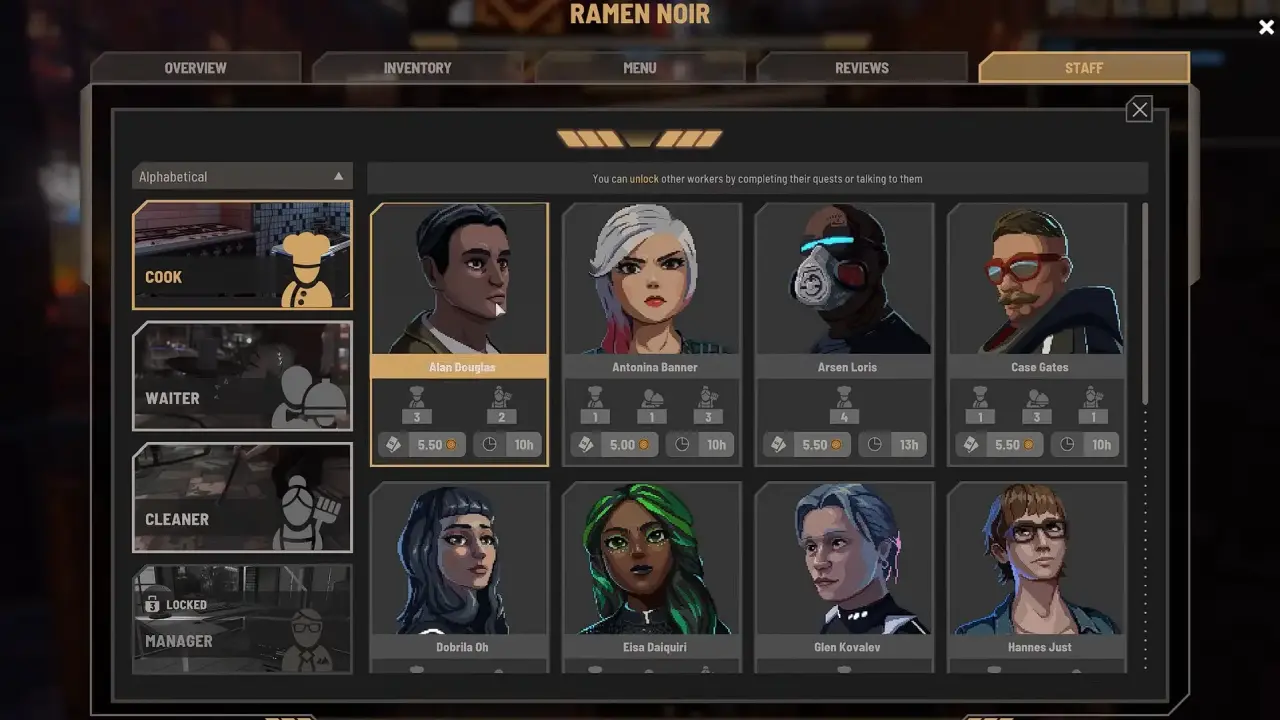
If you have to many employees, you’re wasting money. I found that out the hard way early on when playing, when I also considered that the wages shown were daily wages, and not hourly salaries. Big mistake, but now I know – and you can learn from my mistake.
As far as servers go, three is a great starting point. During the rush, the noodle bar simply has too much work for one or two people.
For cooks, two are enough – at least for my soup setup recommended early on. That soup has just 2 cooking interactions on two separate machines. This is why the magical number here is two, again.
You can click the chef icons in the staff system to enable or disable cooking for individual employees.
That gives you more control than simply hiring people and leaving every role switched on.
One dedicated cleaner is also enough early on. A person cleaning has to move far away from the bar, leaving the area where they could otherwise cook or serve for around 1-2 minutes.
A dedicated cleaner also has a poor cost-to-use ratio because the restaurant needs cleaning throughout the day, but the amount of mess is relatively low and infrequent.
Learn Your Rush Hours and Your Dead Hours
I am not sure if that goes in all games, but you will usually have 4 rush hours: one early in the morning, one at noon, and two quick ones in the evening, at 7 and 9 PM.
Make sure the staffing level is sufficient for your rushes because that’s what matters the most. Perform shift changes or reduce active staff during your quiet periods.
For example, one employee can finish their shift while another starts, allowing you to cover the busy parts of the day without having the entire staff roster active for every hour.
The staff tablet at the entrance to the noodle bar is where you can check and adjust working hours. The game pauses while you make these changes, so take your time.
Hire the Right People, Not the Most Skilled People

The job board is where you find new employees and, as I said above, getting the right ones is better than getting the most skilled ones – no matter if you’re just starting or well into the game.
Two things matter the most when it comes to staff:
- How many hours they want to work.
- Which jobs they can perform.
Then there are three basic wage rules to remember. You pay employees by the hour but if you give an employee exactly the number of hours they want, they are happier to work for less pay.
If you extend or shorten those hours away from their preferred target, you need to pay more per hour to maintain the same happiness level.
Employees with more or higher skills also cost more per hour. That means a highly skilled employee is not automatically a good employee for your business if you don’t need or use those skills.
If you want employees who stay on throughout the day, look for people requesting 10+ hours. That gives you a cleaner schedule and reduces the need for constant shift changes.
If your goal is tighter optimization, you can save 1-2 hours of wages in the middle of the day by hiring people who request shorter hours and using them specifically to cover busy periods.
Do Not Build a Restaurant Full of Generalists
Employees with all 3 skills are expensive and you should avoid them as much as possible.
A cheaper specialist can perform the exact job you need without charging you for abilities that are sitting unused.
Chef + Waiter Employees Can Be Surprisingly Efficient
There is one useful middle ground between specialists and expensive generalists.
You can build a team of 3-4 employees with both chef and waiter skills active.
Staff generally move toward the nearest task. That can reduce waiting and travel time while keeping people from standing around with nothing to do.
However, a chef-plus-waiter employee costs more than a dedicated single-skill employee, obviously.
To make the system work financially, reduce the number of active staff and avoid unnecessary overlap.
Spend Time Tuning Employee Hours
This is one of those systems that rewards a little fiddling.
Increase and decrease an employee’s working hours while watching their happiness level change.
Because the game is paused while you do this, you can spend a long time tuning the roster without wasting in-game hours. Try to get each worker as close as possible to the exact hours they want.
That lets you lower their pay while keeping them happy. And because the wage is paid every hour they work, a small hourly difference becomes a much larger expense over time.
If someone is unnecessary or heavily over-skilled for the role you are giving them, replace them.
Raise Your Food Prices Until Customers Push Back
You can change the noodle soup price using the tablet near the entrance. The recommended pricing strategy is extremely simple: if every seat is filled during every rush hour that day, increase the price by +1.
Do that every day until you start seeing empty seats. When customers stop filling the restaurant, lower the price by -1. That’s your sweet spot and the best price for the soup.
If you can maintain a 4-5 star rating, you should be able to creep toward a significantly higher price than the default.
You Can Close Early
Especially early on in your adventure, closing early can give you a few benefits.
But how to do it? Just have no employees working from 23:00 and the shop will automatically close. That gives you a free hour to gather leftover stock and sell it back to merchants.
Get Spoiled Ingredients Out Immediately
When an ingredient goes bad, clean it out as soon as possible. Spoiled ingredients can infect other ingredients and you don’t want that.
Sell those spoiled ingredients to a vendor (you get 0 lims, it’s basically trashing them). But it’s better than letting spoiled food remain in your inventory and cause further problems.
Avoid Getting Managers Early on
Managers sound like exactly what you want, and they are, but not early on in the game.
Their main problem (although recent patches have tried to address that and did so for the most part) is that they can buy too much produce and end up draining your bank account without mercy. So, until this problem is fully fixed, you have to be the manager.
Of course, that doesn’t have to be the whole game. As soon as you have some established money and things are running smoothly, you can get a manager.
Fast Travel Is a Money-Saving Tool
As you unlock new districts, you will use taxis and trains to move around Nivalis. Once you reach a new district and fast travel becomes available on the map, use it.
Otherwise, you can burn half a day and plenty of money moving between taxis and traincars simply to reach the place you were trying to get to.
Customer Types Matters a Lot, Too
Certain quests can increase or decrease the number of specific customer groups.
For example, completing the quest line of a particular obnoxious NPC and insisting on better rewards at the end can lead to more rich customers.
That matters because different groups have different spending habits.
Rich customers:
- Want more variety.
- Want more ingredients per recipe or dish.
- Will pay full price.
Poor customers tend to stick to the lowest-priced item. This means your customer mix should influence your menu and your seating strategy.
If your restaurant is attracting more wealthy customers, a menu designed entirely around the cheapest possible dish may leave money on the table.
To see what kind of customers you’re getting, go to the Menu screen from your Management menu and click Stats.
This screen shows how your clientele is divided from poor to rich and also shows the food types customers want.
Sabotage Other Businesses

Nivalis does give you a much less respectable method of increasing your profits – but it’s something that will happen to you too, so it’s fair game, I would say.
During curfew, you can visit the other businesses in the area and steal one appliance from every business. If you start with the fridge, you cause maximum damage (as those businesses will have no place to store their ingredients).
Without a fridge, other businesses will close for a couple of days, and that’s when you can set your dish prices to the maximum. Customers will still buy from you because you are the only shop open in the area.
Recipe Modifications Can Increase Your Price Range
Some recipes can be modified by changing ingredients or altering the way the dish is cooked.
These modifications can produce recipes with better exclusivity, which gives you a greater price range. But keep in mind that these might require a wider variety of appliances, which might make it less worthwhile in the long run.
Wrapping up
In the end, you see that Nivalis Nights rewards a bit of planning – and you will make a lot more money if you follow the strategies mentioned above. It might seem a bit overwhelming, but these will start coming naturally pretty fast, so don’t be discouraged!
If you found additional easy ways to make a lot of money fast in the game, let us all know in the comments down below!

- Rooms & Exits Kitchen Walkthrough (Level 11, Chapter 3 – Murder Dressed in White) - October 15, 2026
- Rooms & Exits Garden Walkthrough (Level 10, Chapter 3 – Murder Dressed in White) - October 15, 2026
- Rooms & Exits Complete Walkthrough Index by Chapter and Level - October 12, 2026